Author: GlassExpert

  • Chile’s Building Code & Green Building Guide

    Abstract: This comprehensive guide explores Chile’s building regulatory framework, centered on the General Law of Urban Planning and Construction. It details the code’s three-tiered structure (General Law, General Ordinance, Technical Standards), key governing bodies including the Ministry of Housing and Urban Development and the National Institute of Standardization (INN), and the processes of code adoption, administration, and enforcement. Additionally, the guide covers referenced standards, construction practices, and Chile’s proactive efforts in energy efficiency and green building—despite the absence of a national green construction code. Ideal for construction professionals, policymakers, and stakeholders seeking insights into Chile’s building industry regulations and sustainability trajectory.

    Article Guide:

    1. Core Regulatory Framework: Understand the three-level structure of Chile’s national building code and the roles of key oversight bodies;

    2. Code Adoption & Administration: Learn about local-level adoption mechanisms, municipal responsibilities in implementation, and structural review requirements;

    3. Inspection & Liability: Explore the roles of builders, technical inspectors, and municipalities in ensuring construction quality and compliance;

    4. Referenced Standards: Gain clarity on the distinction between voluntary and mandatory standards and INN’s role as an ISO member;

    5. Green Building & Energy Efficiency: Discover Chile’s energy efficiency regulations, thermal standards, and ongoing efforts to develop a comprehensive green code;

    6. Detailed Code Provisions: Dive into technical standards across construction categories, including structural design, materials, and facilities.

    Keywords: Chile building code, General Law of Urban Planning and Construction, INN Chile, Chile energy efficiency standards, Chile green building, Latin America construction regulations, NCh standards, Chile construction practices

    1. Overview of Chile’s National Building Code Framework

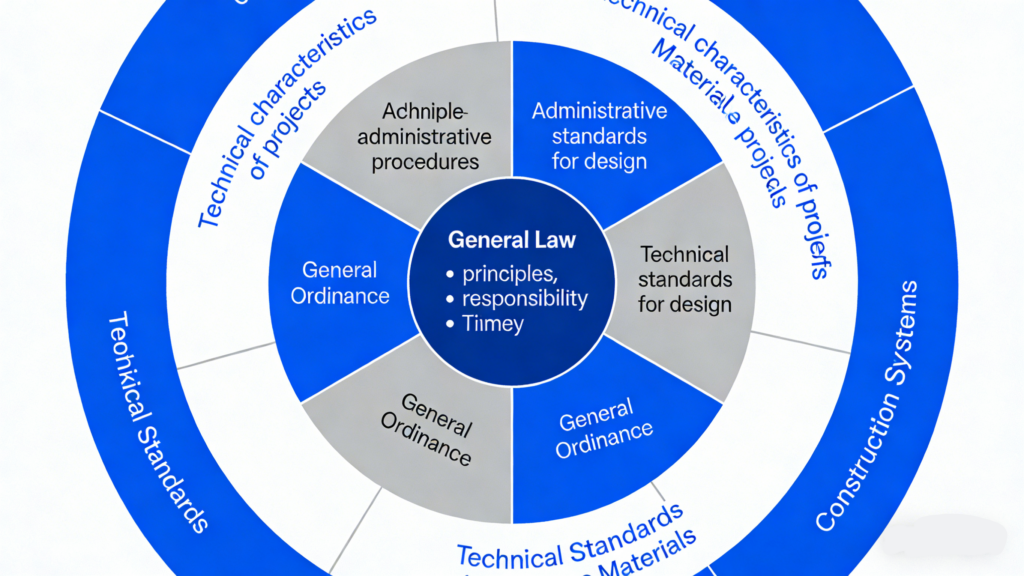
    Chile’s building regulatory system is anchored by the General Law of Urban Planning and Construction (Ley General de Urbanismo y Construcciones), initially established by D.F.L 458 de 1975 and updated by Law 20599 in 2012. This framework operates on a three-tiered structure designed to balance overarching principles, administrative procedures, and technical specificity, ensuring consistency while accommodating local needs.
    1.1 The Three-Tiered Code Structure

    • General Law: Serves as the foundational layer, outlining core principles, functions, powers, responsibilities, duties, penalties, and regulations governing all stakeholders—including government bodies, officials, professionals, and individuals—involved in urban planning, urbanization, and construction.
    • General Ordinance: Translates the General Law into actionable rules, covering administrative procedures, urban planning processes, development and construction protocols, and technical standards for design and construction.
    • Technical Standards: Defines precise technical characteristics of construction projects, materials, and systems to ensure compliance with the requirements set forth in the General Ordinance. These standards are detailed and project-specific.

    1.2 Key Governing & Standard-Setting Bodies

    The development and oversight of Chile’s building codes involve multiple entities working in coordination:

    • Ministry of Housing and Urban Development (Minvu): Plays a central role in approving technical standards (via supreme decree), proposing modifications to the General Law to align with national development needs, and supervising compliance with construction and urbanization regulations. It also interprets land zoning tools and collaborates with professional schools and technical experts to update the General Ordinance in line with technological and economic advancements.
    • National Institute of Standardization (INN): As Chile’s primary standard-setting body and a member of the International Standards Organization (ISO), INN develops most of the country’s building technical standards. These standards are published as individual documents and only become mandatory when cited or incorporated into official regulations (resolutions, decrees, or laws).
    • Regional Secretariat Ministries: Oversee the local adoption of national codes, ensuring regional relevance while maintaining alignment with overarching national principles.
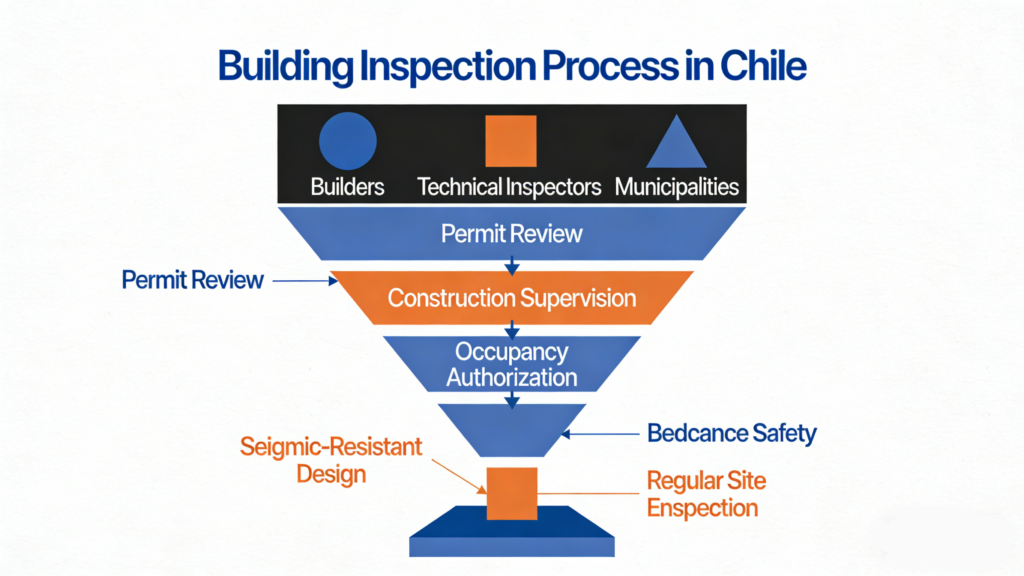
    • Municipalities: Responsible for the on-the-ground implementation of codes through their Department of Municipal Works, which handles permit issuance, construction supervision, and occupancy authorization.

    1.3 International Influences

    Chile’s building code draws significant influence from international standards, particularly those of the United States and Europe. This is partly due to the fact that many Chilean engineering professors are graduates of U.S. and European engineering programs. The code integrates these international best practices with local experience to address Chile’s unique geographic and climatic challenges, such as seismic activity.

    2. Code Adoption, Administration & Construction Practices

    2.1 Localized Code Adoption

    Code adoption in Chile occurs at the local level through regional secretariat ministries. While the core framework is national, regional bodies have the flexibility to adapt standards to address specific regional needs—such as seismic considerations in high-risk areas or climate-specific construction requirements. Minvu retains supervisory authority to ensure consistency across regions and adherence to national principles.

    2.2 Municipal Administration Responsibilities

    Municipalities are the frontline of code administration, with their Department of Municipal Works tasked with a range of critical functions related to code compliance:

    • Approving the subdivision of urban and rural premises
    • Reviewing and approving development and construction projects
    • Granting building permits (a requirement for most construction activities, including reconstruction, repair, alteration, extension, and demolition—with limited exceptions outlined in the General Ordinance)
    • Supervising ongoing construction activities
    • Authorizing building occupancy following compliance verification
    • Conducting inspections to ensure adherence to laws and technical standards
    • Applying environmental regulations related to construction and urbanization

    A key requirement for municipalities is the appointment of a Director of Works, a position reserved for university-educated professionals. In jurisdictions with more than 40,000 inhabitants, this role must be filled by an architect or civil engineer; in smaller areas, a general constructor may qualify. The Director of Works must be a member of the relevant professional school (architecture or engineering).

    Building permits require rigorous review, including approval from an independent structural and seismic reviewer—qualified professionals certified by governmental offices through private schools and organizations. All construction plans and related documents are submitted to the municipal building department and become part of the public record.

    2.3 Commercial & Residential Construction Practices

    Chile’s construction practices vary by region and building type, shaped by local resources and economic factors:

    • Urban Centers: Tall residential and commercial structures primarily use reinforced concrete bearing wall systems. Commercial construction typically employs cast-in-place concrete or confined masonry.
    • Southern Chile: Leveraging extensive forestation, wood frame construction is more common in this region.
    • Industrial & Long-Span Structures: Structural steel is largely limited to industrial facilities, airport terminals, stadiums, and other projects requiring long spans.

    Chile experienced significant economic growth between 1990 and 2010, which drove extensive building development across the country—shaping the current urban and architectural landscape.

    3. Code Inspection & Liability

    Chile’s inspection system is designed to ensure construction quality and compliance, with clear lines of responsibility among stakeholders:

    3.1 Stakeholder Liability

    • Builders: Bear primary liability for any failures, mistakes, or defects in construction—including work performed by subcontractors and the use of defective materials. This ensures builders prioritize adherence to standards throughout the construction process.
    • Technical Inspectors: Serve as independent, competent professionals who supervise compliance with construction standards and building permits. They hold secondary liability alongside builders, meaning they can be held accountable if violations are identified.

    3.2 Inspection Protocols

    Inspection requirements differ between public and private projects:

    • Public Projects: Mandatory external independent construction inspection is required by law and project specifications to ensure transparency and quality.
    • Private Projects: Inspection is optional and dependent on the owner’s preferences. However, it has become a standard practice for medium to large projects or when the project owner is separate from the construction company.

    Municipalities also play a role in inspection, with officials and inspectors typically visiting construction sites every 15 days to verify compliance with township specifications and national laws. Structural engineers further ensure quality by providing detailed drawings and technical specifications (including material requirements, physical properties, and placement geometry) and conducting regular site visits to confirm plans are being followed. They are legally responsible for approving construction progress.
    4. Referenced Standards: Voluntary vs. Mandatory

    All standards developed by INN are inherently voluntary. They only gain mandatory status when explicitly cited or incorporated into official regulations—such as resolutions, decrees, or laws. This system provides flexibility for industries while ensuring critical safety and quality requirements are enforced for construction projects.

    Construction-related standards cover a wide range of topics and are categorized under Area “F” (Basic Construction Standards) of INN’s catalogue. These standards address everything from structural design and materials to facilities and safety, with many drawing on international frameworks to ensure technical rigor.

    5. Green Building & Energy Efficiency Efforts

    While Chile does not yet have a national green construction code, it is a regional leader in building energy efficiency—enjoying broad-based public and private sector support for sustainable practices. This proactive approach positions Chile well to develop a comprehensive green code in the future.

    5.1 Existing Energy Efficiency Regulations

    Chile’s energy efficiency efforts in the building sector are anchored by mandatory thermal regulations:

    • 2000: A thermal regulation for roofs was enacted, establishing maximum heat transmission values tailored to each of Chile’s seven climatic zones.
    • 2007: The regulation was expanded to cover the entire building envelope, including walls, windows, and doors. It is part of the General Ordinance of Urban Planning and Construction and applies to all new residential buildings and retrofits.

    Developed by the nongovernmental Construction Institute with input from industry, consumers, and experts, the current thermal standard is considered relatively lenient compared to international best practices—for example, brick masonry construction alone can satisfy the insulation requirements without additional materials. To address this, work has begun on developing a performance-based standard as an alternative to the current prescriptive standard. This new standard will consider all factors influencing a building’s indoor climate and energy balance, with supporting software already developed and tested.

    5.2 Certification & Support Programs

    Chile’s building certification system is supported by four key pillars: (1) mandatory regulations that establish baseline requirements; (2) official energy calculation systems; (3) system-specific regulations (e.g., for sanitary hot water systems and refrigeration); and (4) objective information (e.g., equipment, appliance, and building labeling).

    The Ministry of Energy’s Program Pais de Eficiencia Energetica (PPEE, Energy Efficient Country Program), in collaboration with Minvu, is driving critical advancements in sustainable building: Development of a Building Energy Efficiency (BEE) certification system for new buildings.Pilot projects subsidizing the construction of new social housing units that exceed current energy efficiency code requirements.Creation of guides for energy-efficient housing.5.3 Path to a National Green CodeChile’s strong foundation in energy efficiency provides a unique opportunity to develop a comprehensive national green building code in collaboration with public and private stakeholders. Key steps to achieve this include identifying gaps in current regulations—beyond energy efficiency to areas like water conservation and renewable energy—and strengthening code implementation and enforcement. These efforts are critical to supporting Chile’s Energy Efficiency Strategy 2020 and advancing the country’s sustainability goals.

    6. Detailed Code Provisions (INN Category “F”)

    INN’s Area “F” (Basic Construction Standards) encompasses a wide range of technical standards covering all aspects of construction. Below is an overview of key subcategories and notable standards, including those aligned with international frameworks:

    6.1 Core Subcategories & Key Standards

    • F.1.1 Basic Standards for Construction: Foundational requirements for all construction projects.
    • F.2.1 General Architectural Design: Includes NCh2077:2000, which is based on ISO/TR 9527:1994 and outlines design guidelines to meet the needs of disabled people in buildings.
    • F.2.2 Modular Coordination: Establishes dimensional requirements for consistent construction.
    • F.2.3 Technical Drawing & Specifications: Governs project presentations and technical documentation.
    • Structural Design (F.3 & Related Subcategories): Critical for Chile’s seismic context, including:
      • NCh433: Earthquake Resistant Design of Buildings (comparable to Chapters 11–22 of ASCE/SEI 7 in the U.S.).
      • NCh430: Reinforced Concrete Design and Analysis Requirements (aligned with ACI 318 in the U.S.).
      • NCh431: Snow Loading (1977).
      • NCh432: Wind Loading (1971).
      • NCh1537: Dead/Live Loads (1986).
      • NCh427: Design of Steel (1977).
      • NCh1198: Design of Wood (2006).
      • NCh1928: Design of Reinforced Masonry (2003).
      • NCh2123: Design of Confined Masonry (2003).
      • NCh2369: Earthquake Resistant Design of Industrial Structures and Facilities (2003).
      • NCh2745: Earthquake Resistant Design of Base Isolated Buildings (2003).
    • Building Performance (F.4): Covers acoustic insulation, thermal insulation, humidity control, natural ventilation, and sustainability (F.4.6).
    • Safety (F.5): Includes fire prevention (F.5.1) and workplace safety with personal protection requirements (F.5.2).
    • Materials (F.6): Encompasses standards for steel and alloys, concrete and mortar, wood, plastics, paints, glass, masonry walls, facades, roofing, asphalt, cement, and more.
    • Facilities (F.7): Governs drinking water installations, sewerage, electricity, gas, heating, ventilation, air conditioning, elevators, and building electrical systems.
    • Tools & Machinery (F.8): Covers construction equipment and tools.
    • Furniture (F.9): Includes standards for appliances, school furniture, and storage units.
  • Canada’s Building & Fire Codes: A Guide to Regulations & Green Initiatives

    Abstract: This guide delves into Canada’s building and fire code framework, covering core model codes, development & enforcement mechanisms, referenced standards, and green building advancements. Administered by the Canadian Commission on Building and Fire Codes (CCBFC), Canada’s national model codes serve as the foundation for provincial/territorial regulations—with flexibility for local adaptations. Key insights include the integration of green features in mandatory codes, provincial variations (e.g., British Columbia, Ontario), and voluntary green building rating systems. Ideal for construction professionals, policymakers, and industry stakeholders seeking a holistic understanding of Canada’s building regulatory landscape.

    Keywords: Canada building codes, National Building Code of Canada, CCBFC, Canadian green building codes, LEED Canada, NECB, Canada fire safety regulations

    Table of Contents:

    1. Overview of Canada’s Building & Fire Code Framework (Core model codes, CCBFC’s role, green features in mandatory codes)

    2. Code Development, Adoption & Enforcement (Key bodies, development process, multi-level enforcement)

    3. Detailed Code Provisions by Category (System-specific requirements, referenced standards organizations)

    4. Green Building Rating Systems in Canada (Mainstream voluntary rating systems, e.g., LEED Canada, Green Globes)

    5. Key Takeaways (Core advantages of Canada’s code system, practical insights)

    1. Overview of Canada’s Building & Fire Code Framework

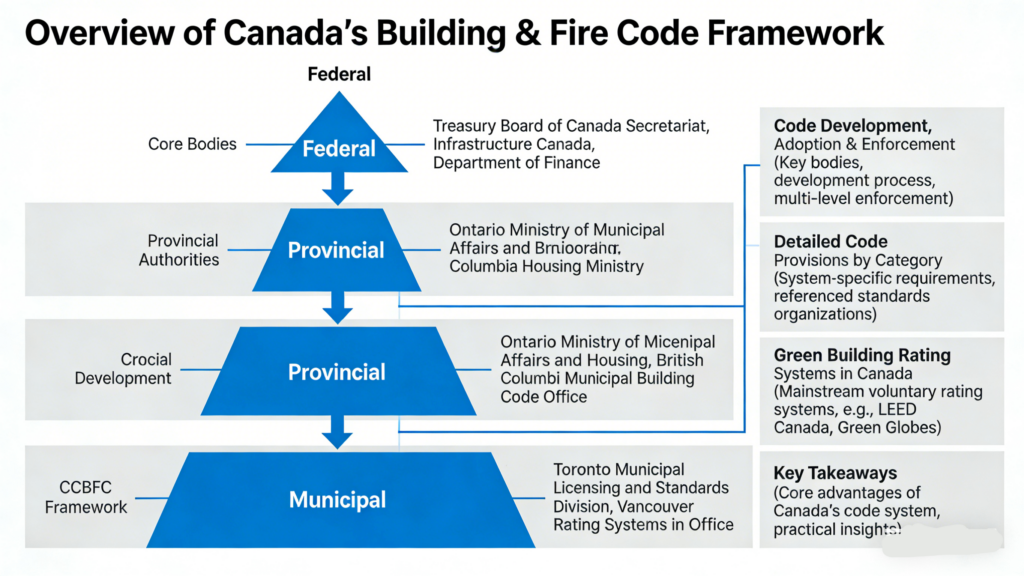
    Canada’s building regulatory system operates on amodel code + provincial adaptation model, balancing national consistency with local relevance. The Canadian Commission on Building and Fire Codes (CCBFC)—established by the National Research Council of Canada—develops and maintains national model codes, while provincial and territorial governments adopt, modify, and enforce these codes to suit regional needs.

    Core characteristics of the system include:

    • Voluntary adoption of national model codes by provinces/territories (not federally mandated), with local governments retaining discretion on enforcement;
    • A consensus-driven code development process involving academia, industry, and government volunteers, with regular public hearings for change requests;
    • Integration of extensive green features (e.g., energy conservation, water efficiency, indoor air quality) into mandatory model codes;
    • Referenced standards from 30+ domestic and international organizations (e.g., CSA, ASHRAE, ASTM International, NFPA).

    1.1 Core National Model Codes

    Canada’s four primary model codes form the backbone of its building regulations, administered by the CCBFC and Canadian Code Center (CCC):

    1. National Building Code of Canada (NBC): Governs general building design, construction, structural safety, and accessibility;
    2. National Fire Code of Canada: Focuses on fire safety, structural protection, and hazard mitigation in buildings;
    3. National Plumbing Code of Canada: Sets standards for plumbing systems, water efficiency, and sanitation;
    4. National Energy Code of Canada (NECB): Establishes minimum energy efficiency requirements for building design and construction (aligned with ASHRAE 90.1).

    1.2 Pathways to Green: Green Features in Mandatory Codes

    Unlike some economies, Canada’s model codes incorporate robust green features as mandatory requirements, including:

    • Indoor air quality (referencing ASHRAE 62.1-2007 and CSA Z204-94);
    • Noise reduction, hazardous material containment, and daylighting requirements;
    • Water conservation (e.g., high-efficiency plumbing fixtures) and sewerage protection;
    • Resource conservation and energy efficiency (via the NECB);
    • Environmental integrity provisions to minimize construction’s ecological footprint.

    Provinces like British Columbia and Ontario have gone a step further, mandating energy-efficient design, solar hot water-ready homes, and renewable energy integration in new constructions.

    2. Code Development, Adoption & Enforcement

    2.1 Key Administrative Bodies

    The code ecosystem involves multiple stakeholders working in tandem to develop, maintain, and enforce regulations:

    • CCBFC: Oversees model code development, approves technical revisions, and manages 10 standing committees (e.g., Structural Design, Energy Efficiency, Fire Protection);
    • Canadian Code Center (CCC): Provides technical and administrative support to the CCBFC and its committees;
    • Provincial/Territorial Policy Advisory Committee on Codes (PTPACC): Advises the CCBFC on regional needs, representing provincial/territorial regulatory bodies;
    • Provincial/Territorial Governments: Adopt and modify model codes, establish enforcement agencies, and run Building Advisory Councils;
    • Local Governments: Discretionarily enforce provincial codes, using in-house or contracted private inspectors.

    2.2 Code Development & Approval Process

    Model codes are developed through a rigorous, consensus-driven process:

    1. Standing/special purpose committees draft code provisions based on industry input and technical research;
    2. Drafts undergo public hearings to gather feedback from stakeholders;
    3. Revisions are made based on public input, and the CCBFC approves the final code documents;
    4. Provincial/territorial governments adopt the model code (with modifications if needed) and convert it into enforceable legislation;
    5. Local governments implement enforcement protocols, including permit issuance and construction inspections.

    Notably, the CCBFC does not set a fixed review or revision周期 (cycle) for model codes—updates are driven by technical advancements and stakeholder needs.

    2.3 Enforcement Mechanisms

    Enforcement varies by jurisdiction but follows a consistent framework:

    • Provincial agencies (e.g., BC’s Ministry of Energy, Mines, and Natural Gas; Ontario’s Ministry of Municipal Affairs and Housing) oversee code compliance;
    • Building officials review plans, issue permits, and conduct on-site inspections;
    • The public can comment on codes via online forms or annual public forums;
    • For indoor air quality (where local enforcement is inconsistent), the “general duty clause” in occupational health and safety legislation mandates employers provide a safe, healthy workplace—including clean air.

    3. Detailed Code Provisions by Category

    3.1 Minimum Codes for Key Building Systems

    CategoryCore Regulations/StandardsKey Requirements
    ElectricalCanadian Electrical Code (CSA C22.1)Installation/maintenance of electrical equipment; references standards from CSA, IEEE, NFPA, UL, etc.
    EnergyNational Energy Code of Canada (NECB)Minimum requirements for building envelope, lighting, HVAC, service water heating, and energy performance (aligned with ASHRAE 90.1).
    Water & SanitationNational Plumbing CodeProvincially modified; BC mandates high-efficiency toilets/solar-ready homes; Ontario adds water efficiency standards.
    Water QualityHealth Canada guidelines; Environment Canada regulationsFederal minimum standards; provinces manage local water quality programs.
    Mechanical SystemsNational Building Code; Energy Efficiency CodeCovers ventilating equipment, pipe couplings, refrigeration (references CSA standards like CAN/CSA-C260-M90).
    Indoor Air QualityASHRAE 62.1-2007; CSA Z204-94Mandatory ventilation standards; enforced via provincial rules or employer “general duty clause.”
    LightingFederal Energy Efficiency Act 1992; Occupational Health and Safety RegulationsEnergy-efficient lighting compliance; workplace lighting level standards enforced by the Ministry of Labour.
    SecurityTreasury Board operational security standards; Public Works Government Security PolicyNo mandatory building security code; guidelines for federal facilities and private buildings.
    FireNational Fire Code of CanadaFire safety, structural protection; references standards from NFPA, CSA, ASTM International, etc.
    StructuralNational Building Code (Part 4); CSA standards (e.g., A23.3-04, S16-01)Structural loads, foundations, material design (wood, concrete, steel), special structures (parking, air-supported).
    Location/Siting/ZoningMunicipal zoning bylaws; Environmental Protection Act 1999Municipality-specific rules; federal environmental regulations for siting and pollution control.

    3.2 Key Referenced Standards Organizations

    Canada’s codes draw on standards from 30+ organizations, including:

    • Canadian: Canadian Standards Association (CSA), Bureau de normalization du Québec (BNQ), Canadian General Standards Board (CGSB), Canadian Wood Council (CWC), Heating, Refrigeration and Air-conditioning Institute of Canada (HRAI), Natural Resources Canada (NRCan), UL Canada;
    • International: ASHRAE, ASTM International, ISO, IEC, NFPA, ANSI, ASME, UL.

    The CSA is particularly influential, developing standards for building materials, structural design, electrical work, energy efficiency, and occupational health and safety.

    4. Green Building Rating Systems in Canada

    In addition to mandatory green features in model codes, Canada boasts a robust ecosystem of voluntary green building rating systems:

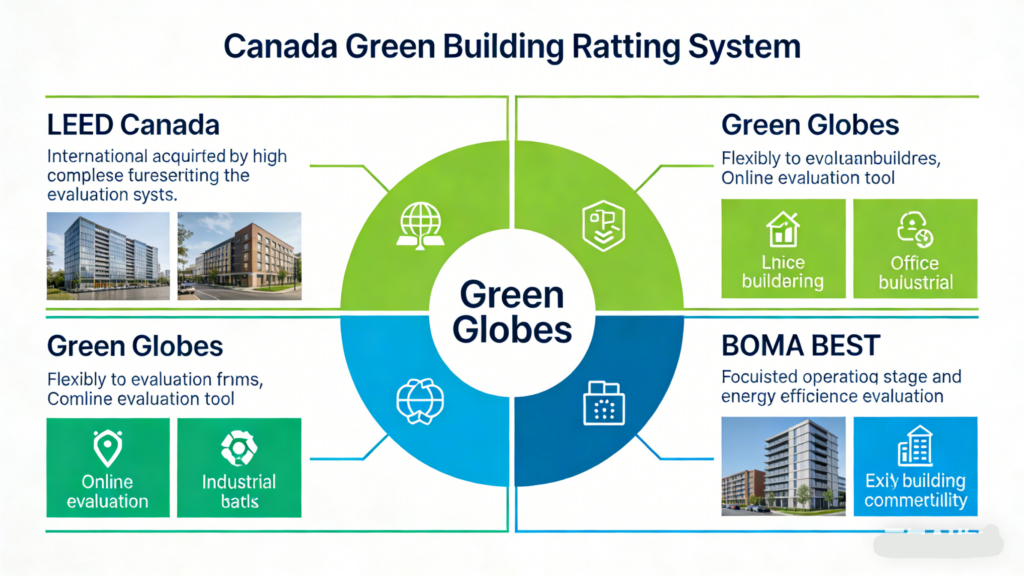
    • BOMA BEST: Focuses on commercial building sustainability and operational efficiency;
    • CSA BREEAM Canada: Adapts the global BREEAM framework to Canadian contexts;
    • CSA Climate Change Buildings and Infrastructure: Addresses climate resilience in construction;
    • Green Globes: A flexible, performance-based rating system for new and existing buildings;
    • LEED® Canada: Tailored to Canadian climate and building practices (for new construction, major renovations, and operations);
    • NRCan ENERGY STAR®: Recognizes energy-efficient buildings and appliances;
    • EnerGuide: Rates building energy performance;
    • R-2000: Focuses on energy efficiency, indoor air quality, and durability in residential buildings.

    5. Key Takeaways

    Canada’s building and fire code system is a dynamic, consensus-driven framework that balances national consistency with local adaptability. Key strengths include the early integration of green features into mandatory codes, provincial leadership in sustainability, and a diverse range of voluntary green building rating systems. For industry professionals, understanding the hierarchy of codes (federal → provincial → municipal) and the role of organizations like the CCBFC and CSA is critical to ensuring compliance and leveraging sustainable building practices.

  • Building Regulations and Green Initiatives in Brunei Darussalam

    Abstract: Brunei Darussalam, an APEC economy, utilizes building regulations rather than unified building codes under a centralized governance structure. This article comprehensively explores Brunei’s building regulatory framework, including referenced standards, administration and enforcement mechanisms, detailed code provisions across professional fields, and ongoing green building efforts. Key insights cover the flexibility of standard substitution, the role of Qualified Persons (QPs) in enforcement, and the government’s initiatives to promote energy efficiency and sustainable construction. It serves as a practical guide for industry professionals and researchers interested in Brunei’s construction sector.

    1. Synopsis of Brunei’s Building Regulatory Framework

    Brunei Darussalam (Brunei) stands out among APEC economies for its adoption of building regulations instead of universal building codes. Driven by its population size, the country operates a centralized government and enforces a single set of building regulations nationwide—aligning with practices in similarly sized economies.

    Core characteristics of Brunei’s building control regulations include:

    • Explicit provisions on penalties and enforcement authorities, supplemented by standards sourced from multiple domestic and international bodies;
    • Mandatory adoption of referenced standards, with a flexible substitution policy (e.g., companies may use equivalent U.S. standards if more familiar);
    • Integration of Brunei Standards and international codes (e.g., ICC’s International Fire Code, WHO guidelines) into key legislations;
    • Absence of dedicated green building codes or mandatory green features in current regulations, offset by government-led energy efficiency and green building initiatives.

    1.1 Referenced Standards

    Brunei’s Building Control Act and Town and Country Planning Development Control Act form the legal basis for adopting standards, with a core principle of accepting equivalent alternatives to referenced standards. The standards framework includes two main categories:

    1. Brunei Standards
      1. Building materials standards: Cover testing, installation, and guidelines for steel, concrete, timber, piles, water, welding, bricks, and other building elements;
      2. Safety standards: Encompass roadway and traffic safety, timber scaffolding, development quality, safety audits, safety organization, design guidelines, traffic signboards, joints and connections, formwork and falsework, drainage, and earthworks.
    2. International Standards
      1. ISO/IEC/PBD Standards (e.g., 820, 1098, 1324, 2036, 2426): Focus on fluorescent lamps, household electrical appliances, wood flooring, plywood, particle boards, timber structures, and quality management systems (ISO 9000 series, ISO 17025, etc.);
      2. Specialized international codes: ICC’s International Fire Code and WHO’s guidelines on water quality and plumbing practices.

    1.2 Code Administration and Enforcement

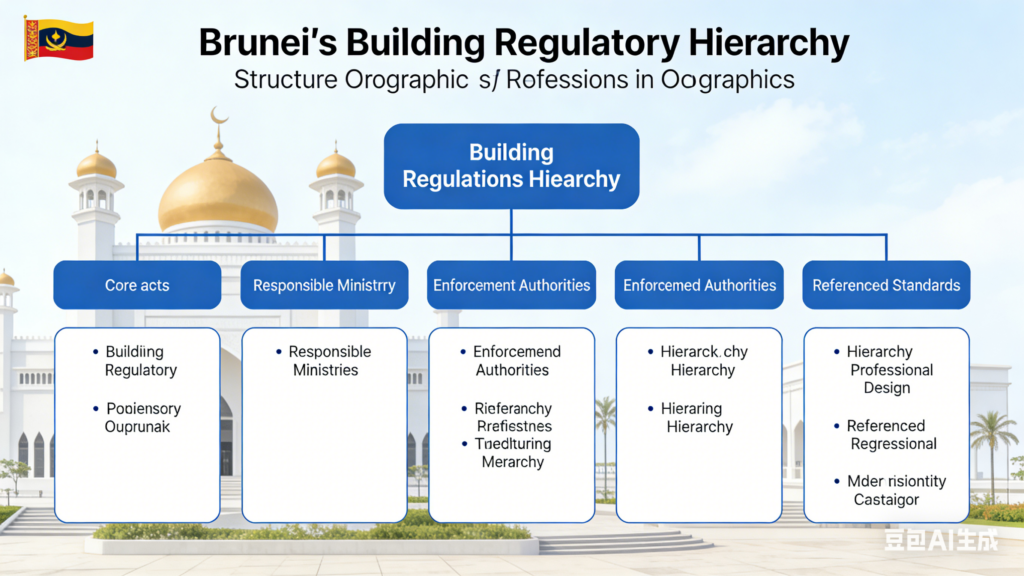
    Brunei’s building regulations are administered and enforced by respective ministries through designated departments and sections, with clear division of responsibilities:

    • Ministry of Development’s Construction Planning and Research Unit: Leads standard adoption/development, evaluates standard applicability, researches enforcement practices, and recommends regulatory updates;
    • Qualified Person (QP): A private-sector professional (registered architect/engineer with relevant experience, unaffiliated with the government) responsible for inspecting building drawings, verifying compliance with standards, and overseeing construction quality. QPs bear full liability for building failures;
    • Building Control Division: Issues building permits and certificates, contingent on QP approval of designs and construction;
    • Specialized Ministries: Enforce international codes within their scope (e.g., Department of Fire and Emergency enforces the ICC Fire Code; Ministry of the Environment enforces WHO’s water quality and plumbing guidelines).

    Notably, there is no fixed timeline for reviewing or revising regulations. Updates are typically led by government-appointed special committees.

    1.3 Green Building Pathways: Government-Led Efforts

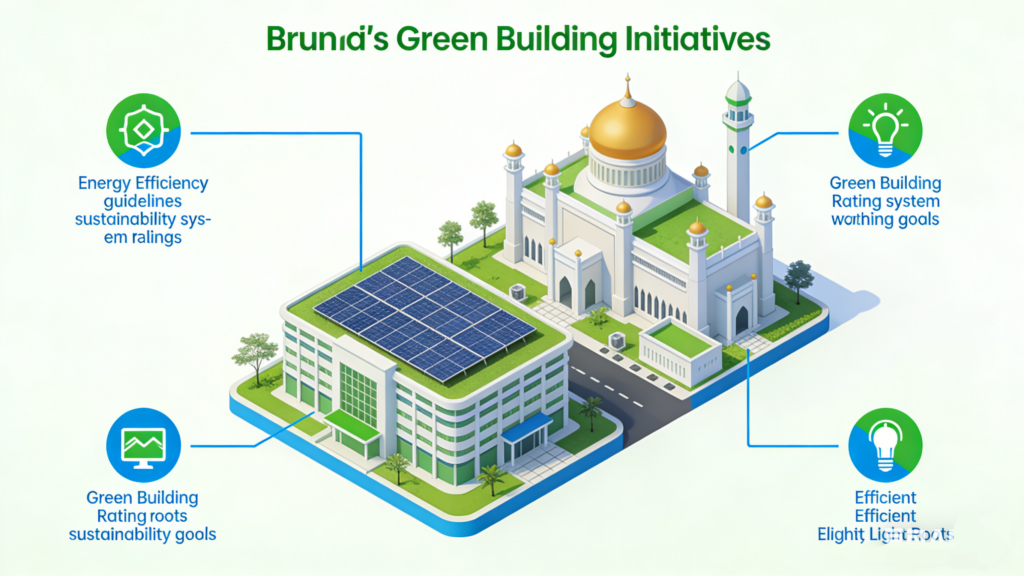
    While Brunei currently lacks green building codes and mandatory green features in existing regulations, the government has taken proactive steps to advance sustainability:

    • Development of the Energy Efficiency and Conservation (EE&C) Guideline;
    • Launch of a green building rating system (under the Green Building Initiatives, GBI);
    • These measures lay the groundwork for integrating green requirements into future building regulations.

    2. Code Development, Administration, and Enforcement in Detail

    2.1 Minimum and Mandatory Codes

    Four key legislations govern building design and construction in Brunei, all published in Malay and mandatory for compliance:

    1. Town and Country Planning Act
    2. Town and Country Planning Development Control Act
    3. Master Plan Act
    4. Building Control Act

    These acts are supplemented by detailed guidelines covering commercial development standards, land/building planning permission procedures, and earthwork development requirements. Collectively, they provide comprehensive technical specifications for building design, planning, and construction.

    Applicability: The regulations apply to all building types except low-rise residential buildings.

    2.2 Enforcement of the Building Control Act

    The Building Control Act regulates construction activities and detailed building design, with the QP playing a pivotal role in enforcement:

    • QPs must inspect and approve building drawings, documents, and construction works to ensure compliance with standards;
    • The Building Control Division issues permits only after QP approval is secured;
    • QPs are fully accountable for any structural or safety failures resulting from non-compliance.

    Additionally, the Act includes guidelines on slope protection, site safety assessment, workmanship quality, construction site safety, laboratory audit methods, material testing procedures, and basic building requirements.

    2.3 Code Adoption and Evolution

    Regulatory administration is decentralized by legislation:

    • Building Control Act: Administered by the Building Control Division;
    • Town and Country Planning Act, Town and Country Planning Development Control Act, Master Plan Act: Administered by the Ministry of Development.

    The development and revision process involves:

    1. Government-appointed special committees drafting revisions;
    2. Ministries refining drafts into official bills;
    3. Parliamentary approval by majority vote;
    4. Endorsement by the Sultan of Brunei;
    5. Implementation by relevant departments via respective ministries.

    There is no fixed timeline for updates. The Building Control Act was last revised in 2002, reflecting the lengthy nature of the legislative process.

    3. Detailed Code Provisions Across Professional Fields

    3.1 Minimum Codes by Category

    CategoryKey Regulations/StandardsCritical Details
    ElectricalElectrical Act 1973, Electrical Act (Amendment Order) 2002, Electricity Act 2011; DES Guidelines on Proper Installation and Use of Electrical WiringsLegislation focuses on penalties/enforcement; DES guidelines are based on IEE Wiring Regulations (BS 7671:2001) with Amendments 1 & 2.
    EnergyNon-mandatory Energy Efficiency and Conservation (EE&C) Guideline; Energy Management Guide; Energy Labeling for Air ConditionersNo mandatory energy efficiency standards or labeling. EE&C goals: raise awareness, develop regulations, improve energy use efficiency, and promote energy-efficient appliances.
    Water and SanitationWHO Code of Practices for Plumbing; WHO Drinking Water Quality Guidelines (1993)No mandatory local plumbing codes. Administered by PWD (Water Services Section for water quality; Drainage and Sewerage Services for sanitation). All facilities are government-operated.
    Mechanical SystemsNoneNo mandatory codes for mechanical systems.
    Indoor Air QualityNoneNo mandatory requirements.
    LightingEE&C Guideline (non-mandatory)No mandatory lighting codes; EE&C includes voluntary provisions for energy-efficient lighting.
    SecurityNoneNo mandatory security codes.
    FireBrunei Internal Fire Code; ICC International Fire Code; PBD 12 of 1994; DES Electrical Installation GuidelinesPBD 12 and DES guidelines include non-mandatory fire safety standards. Enforcement led by Brunei Fire and Rescue Department.
    StructuralBuilding Control Act; Town and Country Planning Development Control ActGeneral structural standards in Building Control Act; excavation and soil-related codes in Development Control Act.
    Location, Siting, Zoning & EnvironmentTown and Country Planning Act; National Land Use Master Plan; Environmental OrderMaster Plan dictates land use (district/local/regional levels). Environmental Order regulates pollution, hazardous substances, and EIA requirements; administered by Department of Environment, Parks and Recreation.
    SafetyNoneNo dedicated safety code; requirements are scattered across relevant regulations.

    3.2 Green Building Codes and Rating System

    As of the latest update, Brunei does not have a mandatory green building code, nor have green features been integrated into minimum or mandatory regulations.

    However, the Ministry of Development launched the Green Building Initiatives (GBI) in March 2012. While no active website or detailed public information was available at the time of the original report, government sources suggest:

    • The GBI will be administered by the Ministry of Development;
    • The initiative is likely to adopt standards from Singapore’s Green Mark and USGBC’s LEED rating systems.
  • A Guide to the Australian National Construction Code (NCC): Administration, Enforcement, and Green Standards

    Synopsis

    This article provides a comprehensive overview of Australia’s regulatory framework for the building industry. It explores the centralized role of the Australian Building Codes Board (ABCB) in managing the National Construction Code (NCC) and explains how state and territory governments enforce these mandatory requirements. The post also details the integration of sustainability through the GEMS Act and the voluntary Green Star rating system, alongside technical standards for electrical, energy, and fire safety.


    1. Code Administration and Enforcement

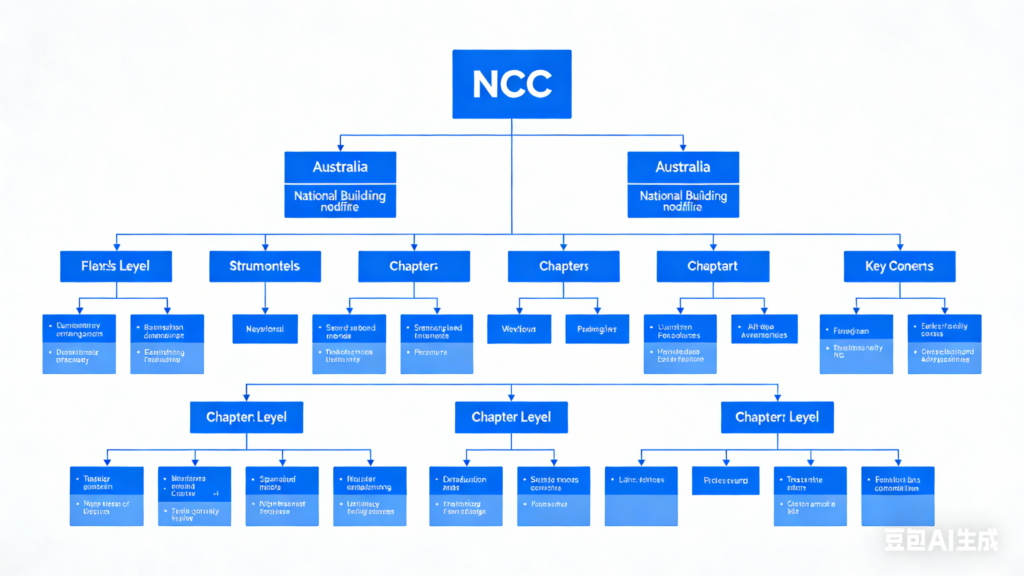
    Australia utilizes a centralized approach to building code administration. The Australian Building Codes Board (ABCB) is the core body responsible for developing, maintaining, and administering the National Construction Code (NCC) on behalf of the Commonwealth as well as state and territory governments.

    The Role of the NCC

    Under the Inter-Governmental Agreement, the NCC is mandatory for all of Australia. It prevails over any conflicting local codes and regulations, ensuring a uniform set of technical provisions across the country while allowing for variations in climate and geological conditions.

    Enforcement and Privatization

    While the NCC is a national standard, the responsibility for enforcement lies with individual states and territories.

    • Authority: State governments issue building permits and commissioning certificates.
    • Privatization: Since the 1990s, building inspections and certifications have been largely privatized. Governments and local councils often engage private sector investigators to conduct inspections to enhance productivity.

    2. Development and Structure of the Code

    The NCC is comprised of three distinct volumes that ensure the health, safety, amenity, and sustainability of buildings:

    • Volume 1: Building Code of Australia (BCA) – Applicable to all buildings except housing.
    • Volume 2: Building Code of Australia (BCA) – Applicable specifically to housing.
    • Volume 3: Plumbing Code of Australia (PCA) – Focuses on plumbing and drainage.

    Building Classifications

    The NCC divides buildings into four types based on their level of importance and hazard to life:

    1. Low Hazard: Structures with a low degree of hazard to life (e.g., farm sheds).
    2. Standard: Buildings not covered by categories 1, 3, or 4.
    3. High Occupancy: Buildings designed for a large number of people.
    4. Essential: Facilities essential to post-disaster recovery or associated with hazardous facilities.

    3. Key Technical and Reference Standards

    Australia relies on a mix of domestic and international standards to maintain its construction quality.

    • National Standards: Primarily uses Australian Standards (AS) and joint Australia/New Zealand Standards (AS/NZS) developed by Standards Australia.
    • International Standards: The NCC also references selective standards from the U.S. (ASTM, AISC), Europe (ISO), and the UK (BSI).

    Minimum Code Requirements

    • Electrical: Governed by the BCA and National Electricity Rules (NER), mandating AS/NZS 3000:2007 (Australian Wiring Rules).
    • Fire Safety: Covers fire resistance testing (AS/NZS 1530), protection methods, and prevention systems.
    • Mechanical: Regulates HVAC, lifts, and escalators through standards like AS 1668 and AS 1735.

    4. Pathways to Green Building

    Sustainability in Australia is driven through legislative integration rather than a separate “Green Code.”

    Mandatory Legislation

    Green features are incorporated into the NCC through acts such as:

    • GEMS Act 2012: Regulates energy efficiency for appliances (lighting, air conditioning, motors).
    • Water Act 2007: Establishes efficiency and quality standards for faucets and fixtures.
    • MEPS & ERL: Products must comply with Minimum Energy Performance Standards and Energy Rating Labels.

    The Green Star Rating System

    Launched in 2003 by the Green Building Council of Australia, Green Star is a voluntary rating system that scores buildings across nine categories, including indoor environment quality and emissions.

    ScoreRatingSignification
    45-594-StarBest Practice
    60-745-StarAustralian Excellence
    75-1006-StarWorld Leadership

    Here is a detailed summary table of the specific Australian and International Standards mentioned in your document. You can insert this table into your WordPress post to provide a high-quality technical reference for your readers.

    Quick Reference: Key Standards within the NCC

    CategoryStandard IDDescription / Application
    ElectricalAS/NZS 3000:2007Australian Wiring Rules: The primary standard for all electrical installations.
    ElectricalAS/NZS 3017:2007Verification Guidelines: Sets out inspection and testing for low voltage installations.
    MechanicalAS/NZS 1668Use of mechanical ventilation and air-conditioning in buildings.
    MechanicalAS 1735Standard for lifts, escalators, and moving walks.
    MechanicalAS 4254Requirements for ductwork for air-handling systems.
    Fire SafetyAS/NZS 1530Methods for fire tests on building materials, components, and structures.
    Fire SafetyAS 1670 / 1905Fire protection methods against fire hazards and fire-resistant doorsets.
    Fire SafetyAS 2118 / 2441Automatic fire sprinkler systems and fire hose reels.
    LightingAS/NZS 1680Interior and workplace lighting requirements.
    LightingAS 2293Emergency escape lighting and exit signs for buildings.
    PlumbingAS/NZS 3500National plumbing and drainage standards.
    InternationalARI 550/590(U.S.) Water chilling packages using the vapor compression cycle.
    InternationalBS 7190(U.K.) Assessing thermal performance of low-temperature hot water boilers.
    InternationalAISC 1987(U.S.) Steel construction standards used in fire prevention inspection.