Abstract: Brunei Darussalam, an APEC economy, utilizes building regulations rather than unified building codes under a centralized governance structure. This article comprehensively explores Brunei’s building regulatory framework, including referenced standards, administration and enforcement mechanisms, detailed code provisions across professional fields, and ongoing green building efforts. Key insights cover the flexibility of standard substitution, the role of Qualified Persons (QPs) in enforcement, and the government’s initiatives to promote energy efficiency and sustainable construction. It serves as a practical guide for industry professionals and researchers interested in Brunei’s construction sector.
1. Synopsis of Brunei’s Building Regulatory Framework
Brunei Darussalam (Brunei) stands out among APEC economies for its adoption of building regulations instead of universal building codes. Driven by its population size, the country operates a centralized government and enforces a single set of building regulations nationwide—aligning with practices in similarly sized economies.
Core characteristics of Brunei’s building control regulations include:
- Explicit provisions on penalties and enforcement authorities, supplemented by standards sourced from multiple domestic and international bodies;
- Mandatory adoption of referenced standards, with a flexible substitution policy (e.g., companies may use equivalent U.S. standards if more familiar);
- Integration of Brunei Standards and international codes (e.g., ICC’s International Fire Code, WHO guidelines) into key legislations;
- Absence of dedicated green building codes or mandatory green features in current regulations, offset by government-led energy efficiency and green building initiatives.
1.1 Referenced Standards
Brunei’s Building Control Act and Town and Country Planning Development Control Act form the legal basis for adopting standards, with a core principle of accepting equivalent alternatives to referenced standards. The standards framework includes two main categories:
- Brunei Standards
- Building materials standards: Cover testing, installation, and guidelines for steel, concrete, timber, piles, water, welding, bricks, and other building elements;
- Safety standards: Encompass roadway and traffic safety, timber scaffolding, development quality, safety audits, safety organization, design guidelines, traffic signboards, joints and connections, formwork and falsework, drainage, and earthworks.
- International Standards
- ISO/IEC/PBD Standards (e.g., 820, 1098, 1324, 2036, 2426): Focus on fluorescent lamps, household electrical appliances, wood flooring, plywood, particle boards, timber structures, and quality management systems (ISO 9000 series, ISO 17025, etc.);
- Specialized international codes: ICC’s International Fire Code and WHO’s guidelines on water quality and plumbing practices.
1.2 Code Administration and Enforcement
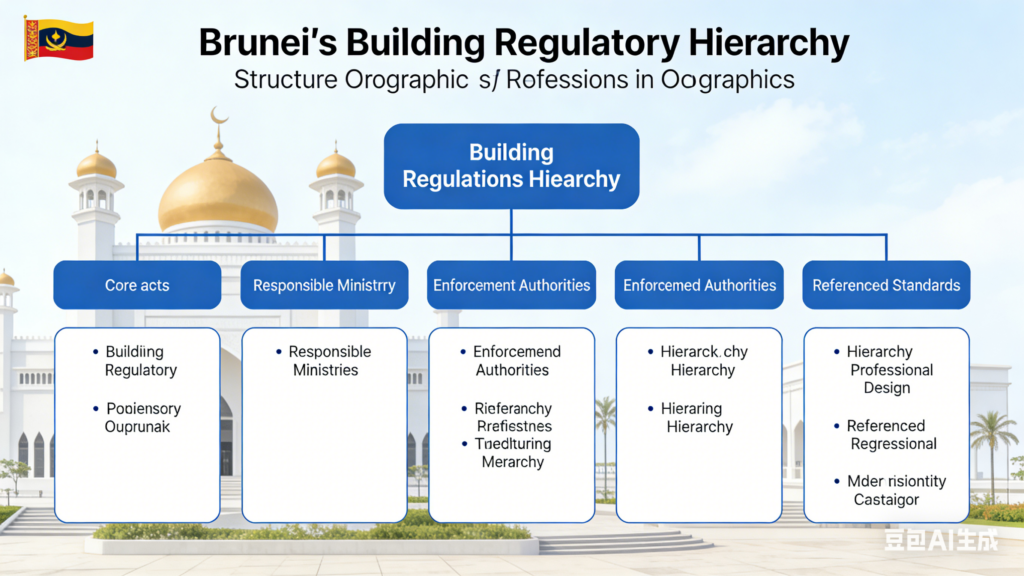
Brunei’s building regulations are administered and enforced by respective ministries through designated departments and sections, with clear division of responsibilities:
- Ministry of Development’s Construction Planning and Research Unit: Leads standard adoption/development, evaluates standard applicability, researches enforcement practices, and recommends regulatory updates;
- Qualified Person (QP): A private-sector professional (registered architect/engineer with relevant experience, unaffiliated with the government) responsible for inspecting building drawings, verifying compliance with standards, and overseeing construction quality. QPs bear full liability for building failures;
- Building Control Division: Issues building permits and certificates, contingent on QP approval of designs and construction;
- Specialized Ministries: Enforce international codes within their scope (e.g., Department of Fire and Emergency enforces the ICC Fire Code; Ministry of the Environment enforces WHO’s water quality and plumbing guidelines).
Notably, there is no fixed timeline for reviewing or revising regulations. Updates are typically led by government-appointed special committees.
1.3 Green Building Pathways: Government-Led Efforts
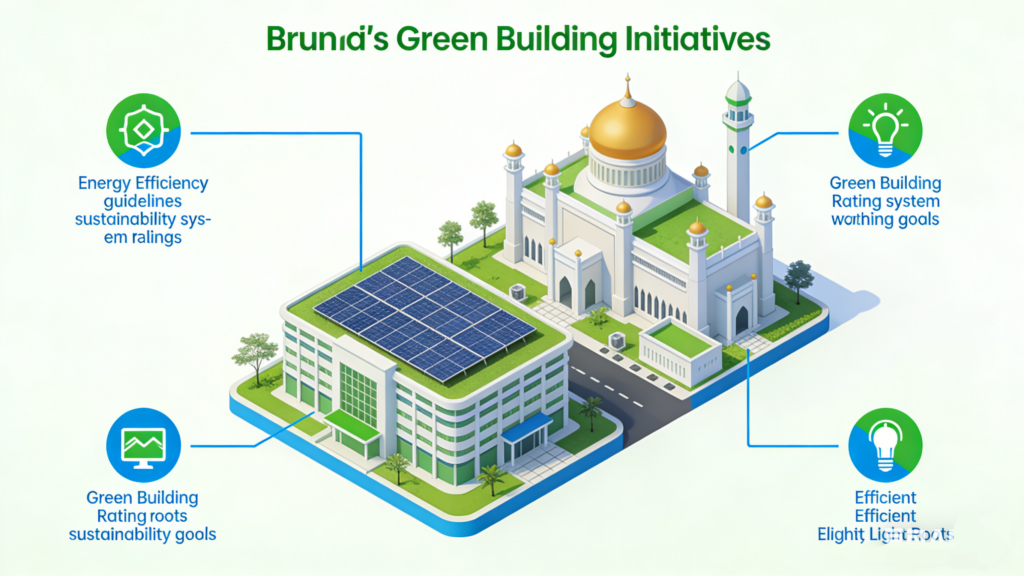
While Brunei currently lacks green building codes and mandatory green features in existing regulations, the government has taken proactive steps to advance sustainability:
- Development of the Energy Efficiency and Conservation (EE&C) Guideline;
- Launch of a green building rating system (under the Green Building Initiatives, GBI);
- These measures lay the groundwork for integrating green requirements into future building regulations.
2. Code Development, Administration, and Enforcement in Detail
2.1 Minimum and Mandatory Codes
Four key legislations govern building design and construction in Brunei, all published in Malay and mandatory for compliance:
- Town and Country Planning Act
- Town and Country Planning Development Control Act
- Master Plan Act
- Building Control Act
These acts are supplemented by detailed guidelines covering commercial development standards, land/building planning permission procedures, and earthwork development requirements. Collectively, they provide comprehensive technical specifications for building design, planning, and construction.
Applicability: The regulations apply to all building types except low-rise residential buildings.
2.2 Enforcement of the Building Control Act
The Building Control Act regulates construction activities and detailed building design, with the QP playing a pivotal role in enforcement:
- QPs must inspect and approve building drawings, documents, and construction works to ensure compliance with standards;
- The Building Control Division issues permits only after QP approval is secured;
- QPs are fully accountable for any structural or safety failures resulting from non-compliance.
Additionally, the Act includes guidelines on slope protection, site safety assessment, workmanship quality, construction site safety, laboratory audit methods, material testing procedures, and basic building requirements.
2.3 Code Adoption and Evolution
Regulatory administration is decentralized by legislation:
- Building Control Act: Administered by the Building Control Division;
- Town and Country Planning Act, Town and Country Planning Development Control Act, Master Plan Act: Administered by the Ministry of Development.
The development and revision process involves:
- Government-appointed special committees drafting revisions;
- Ministries refining drafts into official bills;
- Parliamentary approval by majority vote;
- Endorsement by the Sultan of Brunei;
- Implementation by relevant departments via respective ministries.
There is no fixed timeline for updates. The Building Control Act was last revised in 2002, reflecting the lengthy nature of the legislative process.
3. Detailed Code Provisions Across Professional Fields
3.1 Minimum Codes by Category
| Category | Key Regulations/Standards | Critical Details |
|---|---|---|
| Electrical | Electrical Act 1973, Electrical Act (Amendment Order) 2002, Electricity Act 2011; DES Guidelines on Proper Installation and Use of Electrical Wirings | Legislation focuses on penalties/enforcement; DES guidelines are based on IEE Wiring Regulations (BS 7671:2001) with Amendments 1 & 2. |
| Energy | Non-mandatory Energy Efficiency and Conservation (EE&C) Guideline; Energy Management Guide; Energy Labeling for Air Conditioners | No mandatory energy efficiency standards or labeling. EE&C goals: raise awareness, develop regulations, improve energy use efficiency, and promote energy-efficient appliances. |
| Water and Sanitation | WHO Code of Practices for Plumbing; WHO Drinking Water Quality Guidelines (1993) | No mandatory local plumbing codes. Administered by PWD (Water Services Section for water quality; Drainage and Sewerage Services for sanitation). All facilities are government-operated. |
| Mechanical Systems | None | No mandatory codes for mechanical systems. |
| Indoor Air Quality | None | No mandatory requirements. |
| Lighting | EE&C Guideline (non-mandatory) | No mandatory lighting codes; EE&C includes voluntary provisions for energy-efficient lighting. |
| Security | None | No mandatory security codes. |
| Fire | Brunei Internal Fire Code; ICC International Fire Code; PBD 12 of 1994; DES Electrical Installation Guidelines | PBD 12 and DES guidelines include non-mandatory fire safety standards. Enforcement led by Brunei Fire and Rescue Department. |
| Structural | Building Control Act; Town and Country Planning Development Control Act | General structural standards in Building Control Act; excavation and soil-related codes in Development Control Act. |
| Location, Siting, Zoning & Environment | Town and Country Planning Act; National Land Use Master Plan; Environmental Order | Master Plan dictates land use (district/local/regional levels). Environmental Order regulates pollution, hazardous substances, and EIA requirements; administered by Department of Environment, Parks and Recreation. |
| Safety | None | No dedicated safety code; requirements are scattered across relevant regulations. |
3.2 Green Building Codes and Rating System
As of the latest update, Brunei does not have a mandatory green building code, nor have green features been integrated into minimum or mandatory regulations.
However, the Ministry of Development launched the Green Building Initiatives (GBI) in March 2012. While no active website or detailed public information was available at the time of the original report, government sources suggest:
- The GBI will be administered by the Ministry of Development;
- The initiative is likely to adopt standards from Singapore’s Green Mark and USGBC’s LEED rating systems.
Leave a Reply