Abstract: This comprehensive guide explores Chile’s building regulatory framework, centered on the General Law of Urban Planning and Construction. It details the code’s three-tiered structure (General Law, General Ordinance, Technical Standards), key governing bodies including the Ministry of Housing and Urban Development and the National Institute of Standardization (INN), and the processes of code adoption, administration, and enforcement. Additionally, the guide covers referenced standards, construction practices, and Chile’s proactive efforts in energy efficiency and green building—despite the absence of a national green construction code. Ideal for construction professionals, policymakers, and stakeholders seeking insights into Chile’s building industry regulations and sustainability trajectory.
Article Guide:
5. Green Building & Energy Efficiency: Discover Chile’s energy efficiency regulations, thermal standards, and ongoing efforts to develop a comprehensive green code;
Keywords: Chile building code, General Law of Urban Planning and Construction, INN Chile, Chile energy efficiency standards, Chile green building, Latin America construction regulations, NCh standards, Chile construction practices
1. Overview of Chile’s National Building Code Framework
Chile’s building regulatory system is anchored by the General Law of Urban Planning and Construction (Ley General de Urbanismo y Construcciones), initially established by D.F.L 458 de 1975 and updated by Law 20599 in 2012. This framework operates on a three-tiered structure designed to balance overarching principles, administrative procedures, and technical specificity, ensuring consistency while accommodating local needs.
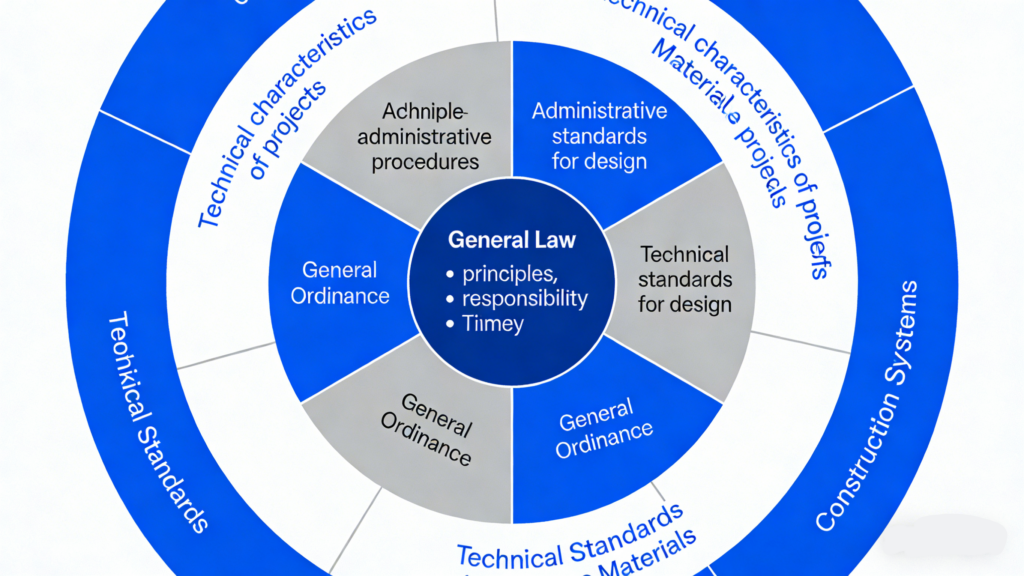
1.1 The Three-Tiered Code Structure
- General Law: Serves as the foundational layer, outlining core principles, functions, powers, responsibilities, duties, penalties, and regulations governing all stakeholders—including government bodies, officials, professionals, and individuals—involved in urban planning, urbanization, and construction.
- General Ordinance: Translates the General Law into actionable rules, covering administrative procedures, urban planning processes, development and construction protocols, and technical standards for design and construction.
- Technical Standards: Defines precise technical characteristics of construction projects, materials, and systems to ensure compliance with the requirements set forth in the General Ordinance. These standards are detailed and project-specific.
1.2 Key Governing & Standard-Setting Bodies
The development and oversight of Chile’s building codes involve multiple entities working in coordination:
- Ministry of Housing and Urban Development (Minvu): Plays a central role in approving technical standards (via supreme decree), proposing modifications to the General Law to align with national development needs, and supervising compliance with construction and urbanization regulations. It also interprets land zoning tools and collaborates with professional schools and technical experts to update the General Ordinance in line with technological and economic advancements.
- National Institute of Standardization (INN): As Chile’s primary standard-setting body and a member of the International Standards Organization (ISO), INN develops most of the country’s building technical standards. These standards are published as individual documents and only become mandatory when cited or incorporated into official regulations (resolutions, decrees, or laws).
- Regional Secretariat Ministries: Oversee the local adoption of national codes, ensuring regional relevance while maintaining alignment with overarching national principles.
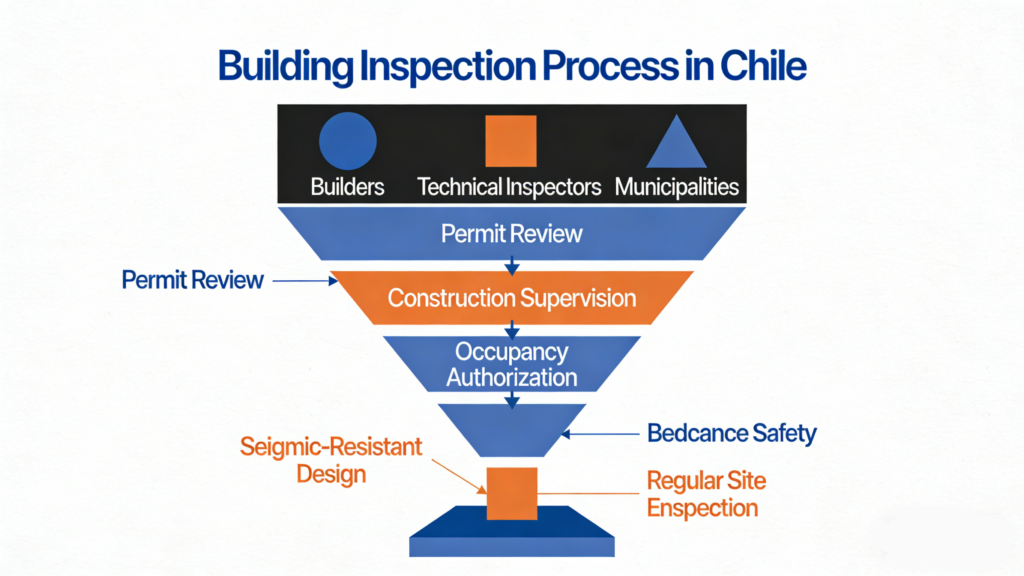
- Municipalities: Responsible for the on-the-ground implementation of codes through their Department of Municipal Works, which handles permit issuance, construction supervision, and occupancy authorization.
1.3 International Influences
Chile’s building code draws significant influence from international standards, particularly those of the United States and Europe. This is partly due to the fact that many Chilean engineering professors are graduates of U.S. and European engineering programs. The code integrates these international best practices with local experience to address Chile’s unique geographic and climatic challenges, such as seismic activity.
2. Code Adoption, Administration & Construction Practices
2.1 Localized Code Adoption
Code adoption in Chile occurs at the local level through regional secretariat ministries. While the core framework is national, regional bodies have the flexibility to adapt standards to address specific regional needs—such as seismic considerations in high-risk areas or climate-specific construction requirements. Minvu retains supervisory authority to ensure consistency across regions and adherence to national principles.
2.2 Municipal Administration Responsibilities
Municipalities are the frontline of code administration, with their Department of Municipal Works tasked with a range of critical functions related to code compliance:
- Approving the subdivision of urban and rural premises
- Reviewing and approving development and construction projects
- Granting building permits (a requirement for most construction activities, including reconstruction, repair, alteration, extension, and demolition—with limited exceptions outlined in the General Ordinance)
- Supervising ongoing construction activities
- Authorizing building occupancy following compliance verification
- Conducting inspections to ensure adherence to laws and technical standards
- Applying environmental regulations related to construction and urbanization
A key requirement for municipalities is the appointment of a Director of Works, a position reserved for university-educated professionals. In jurisdictions with more than 40,000 inhabitants, this role must be filled by an architect or civil engineer; in smaller areas, a general constructor may qualify. The Director of Works must be a member of the relevant professional school (architecture or engineering).
Building permits require rigorous review, including approval from an independent structural and seismic reviewer—qualified professionals certified by governmental offices through private schools and organizations. All construction plans and related documents are submitted to the municipal building department and become part of the public record.
2.3 Commercial & Residential Construction Practices
Chile’s construction practices vary by region and building type, shaped by local resources and economic factors:
- Urban Centers: Tall residential and commercial structures primarily use reinforced concrete bearing wall systems. Commercial construction typically employs cast-in-place concrete or confined masonry.
- Southern Chile: Leveraging extensive forestation, wood frame construction is more common in this region.
- Industrial & Long-Span Structures: Structural steel is largely limited to industrial facilities, airport terminals, stadiums, and other projects requiring long spans.
Chile experienced significant economic growth between 1990 and 2010, which drove extensive building development across the country—shaping the current urban and architectural landscape.
3. Code Inspection & Liability
Chile’s inspection system is designed to ensure construction quality and compliance, with clear lines of responsibility among stakeholders:
3.1 Stakeholder Liability
- Builders: Bear primary liability for any failures, mistakes, or defects in construction—including work performed by subcontractors and the use of defective materials. This ensures builders prioritize adherence to standards throughout the construction process.
- Technical Inspectors: Serve as independent, competent professionals who supervise compliance with construction standards and building permits. They hold secondary liability alongside builders, meaning they can be held accountable if violations are identified.
3.2 Inspection Protocols
Inspection requirements differ between public and private projects:
- Public Projects: Mandatory external independent construction inspection is required by law and project specifications to ensure transparency and quality.
- Private Projects: Inspection is optional and dependent on the owner’s preferences. However, it has become a standard practice for medium to large projects or when the project owner is separate from the construction company.
Municipalities also play a role in inspection, with officials and inspectors typically visiting construction sites every 15 days to verify compliance with township specifications and national laws. Structural engineers further ensure quality by providing detailed drawings and technical specifications (including material requirements, physical properties, and placement geometry) and conducting regular site visits to confirm plans are being followed. They are legally responsible for approving construction progress.
4. Referenced Standards: Voluntary vs. Mandatory
All standards developed by INN are inherently voluntary. They only gain mandatory status when explicitly cited or incorporated into official regulations—such as resolutions, decrees, or laws. This system provides flexibility for industries while ensuring critical safety and quality requirements are enforced for construction projects.
Construction-related standards cover a wide range of topics and are categorized under Area “F” (Basic Construction Standards) of INN’s catalogue. These standards address everything from structural design and materials to facilities and safety, with many drawing on international frameworks to ensure technical rigor.
5. Green Building & Energy Efficiency Efforts
While Chile does not yet have a national green construction code, it is a regional leader in building energy efficiency—enjoying broad-based public and private sector support for sustainable practices. This proactive approach positions Chile well to develop a comprehensive green code in the future.
5.1 Existing Energy Efficiency Regulations
Chile’s energy efficiency efforts in the building sector are anchored by mandatory thermal regulations:
- 2000: A thermal regulation for roofs was enacted, establishing maximum heat transmission values tailored to each of Chile’s seven climatic zones.
- 2007: The regulation was expanded to cover the entire building envelope, including walls, windows, and doors. It is part of the General Ordinance of Urban Planning and Construction and applies to all new residential buildings and retrofits.
Developed by the nongovernmental Construction Institute with input from industry, consumers, and experts, the current thermal standard is considered relatively lenient compared to international best practices—for example, brick masonry construction alone can satisfy the insulation requirements without additional materials. To address this, work has begun on developing a performance-based standard as an alternative to the current prescriptive standard. This new standard will consider all factors influencing a building’s indoor climate and energy balance, with supporting software already developed and tested.
5.2 Certification & Support Programs
Chile’s building certification system is supported by four key pillars: (1) mandatory regulations that establish baseline requirements; (2) official energy calculation systems; (3) system-specific regulations (e.g., for sanitary hot water systems and refrigeration); and (4) objective information (e.g., equipment, appliance, and building labeling).
The Ministry of Energy’s Program Pais de Eficiencia Energetica (PPEE, Energy Efficient Country Program), in collaboration with Minvu, is driving critical advancements in sustainable building: Development of a Building Energy Efficiency (BEE) certification system for new buildings.Pilot projects subsidizing the construction of new social housing units that exceed current energy efficiency code requirements.Creation of guides for energy-efficient housing.5.3 Path to a National Green CodeChile’s strong foundation in energy efficiency provides a unique opportunity to develop a comprehensive national green building code in collaboration with public and private stakeholders. Key steps to achieve this include identifying gaps in current regulations—beyond energy efficiency to areas like water conservation and renewable energy—and strengthening code implementation and enforcement. These efforts are critical to supporting Chile’s Energy Efficiency Strategy 2020 and advancing the country’s sustainability goals.
6. Detailed Code Provisions (INN Category “F”)
INN’s Area “F” (Basic Construction Standards) encompasses a wide range of technical standards covering all aspects of construction. Below is an overview of key subcategories and notable standards, including those aligned with international frameworks:
6.1 Core Subcategories & Key Standards
- F.1.1 Basic Standards for Construction: Foundational requirements for all construction projects.
- F.2.1 General Architectural Design: Includes NCh2077:2000, which is based on ISO/TR 9527:1994 and outlines design guidelines to meet the needs of disabled people in buildings.
- F.2.2 Modular Coordination: Establishes dimensional requirements for consistent construction.
- F.2.3 Technical Drawing & Specifications: Governs project presentations and technical documentation.
- Structural Design (F.3 & Related Subcategories): Critical for Chile’s seismic context, including:
- NCh433: Earthquake Resistant Design of Buildings (comparable to Chapters 11–22 of ASCE/SEI 7 in the U.S.).
- NCh430: Reinforced Concrete Design and Analysis Requirements (aligned with ACI 318 in the U.S.).
- NCh431: Snow Loading (1977).
- NCh432: Wind Loading (1971).
- NCh1537: Dead/Live Loads (1986).
- NCh427: Design of Steel (1977).
- NCh1198: Design of Wood (2006).
- NCh1928: Design of Reinforced Masonry (2003).
- NCh2123: Design of Confined Masonry (2003).
- NCh2369: Earthquake Resistant Design of Industrial Structures and Facilities (2003).
- NCh2745: Earthquake Resistant Design of Base Isolated Buildings (2003).
- Building Performance (F.4): Covers acoustic insulation, thermal insulation, humidity control, natural ventilation, and sustainability (F.4.6).
- Safety (F.5): Includes fire prevention (F.5.1) and workplace safety with personal protection requirements (F.5.2).
- Materials (F.6): Encompasses standards for steel and alloys, concrete and mortar, wood, plastics, paints, glass, masonry walls, facades, roofing, asphalt, cement, and more.
- Facilities (F.7): Governs drinking water installations, sewerage, electricity, gas, heating, ventilation, air conditioning, elevators, and building electrical systems.
- Tools & Machinery (F.8): Covers construction equipment and tools.
- Furniture (F.9): Includes standards for appliances, school furniture, and storage units.
Leave a Reply