Abstract: This guide delves into Canada’s building and fire code framework, covering core model codes, development & enforcement mechanisms, referenced standards, and green building advancements. Administered by the Canadian Commission on Building and Fire Codes (CCBFC), Canada’s national model codes serve as the foundation for provincial/territorial regulations—with flexibility for local adaptations. Key insights include the integration of green features in mandatory codes, provincial variations (e.g., British Columbia, Ontario), and voluntary green building rating systems. Ideal for construction professionals, policymakers, and industry stakeholders seeking a holistic understanding of Canada’s building regulatory landscape.
Keywords: Canada building codes, National Building Code of Canada, CCBFC, Canadian green building codes, LEED Canada, NECB, Canada fire safety regulations
Table of Contents:
1. Overview of Canada’s Building & Fire Code Framework (Core model codes, CCBFC’s role, green features in mandatory codes)
2. Code Development, Adoption & Enforcement (Key bodies, development process, multi-level enforcement)
3. Detailed Code Provisions by Category (System-specific requirements, referenced standards organizations)
4. Green Building Rating Systems in Canada (Mainstream voluntary rating systems, e.g., LEED Canada, Green Globes)
5. Key Takeaways (Core advantages of Canada’s code system, practical insights)
1. Overview of Canada’s Building & Fire Code Framework
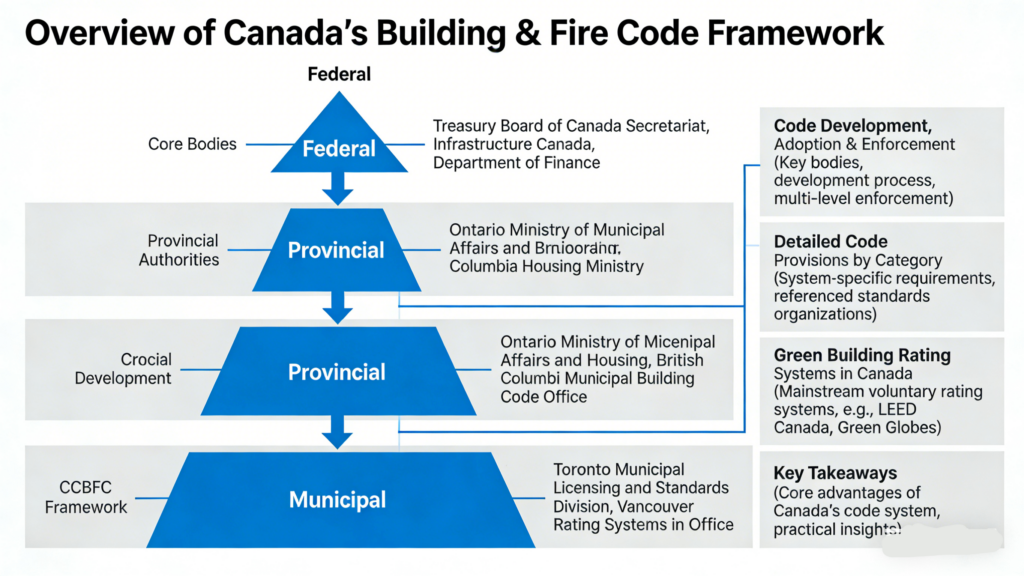
Canada’s building regulatory system operates on amodel code + provincial adaptation model, balancing national consistency with local relevance. The Canadian Commission on Building and Fire Codes (CCBFC)—established by the National Research Council of Canada—develops and maintains national model codes, while provincial and territorial governments adopt, modify, and enforce these codes to suit regional needs.
Core characteristics of the system include:
- Voluntary adoption of national model codes by provinces/territories (not federally mandated), with local governments retaining discretion on enforcement;
- A consensus-driven code development process involving academia, industry, and government volunteers, with regular public hearings for change requests;
- Integration of extensive green features (e.g., energy conservation, water efficiency, indoor air quality) into mandatory model codes;
- Referenced standards from 30+ domestic and international organizations (e.g., CSA, ASHRAE, ASTM International, NFPA).
1.1 Core National Model Codes
Canada’s four primary model codes form the backbone of its building regulations, administered by the CCBFC and Canadian Code Center (CCC):
- National Building Code of Canada (NBC): Governs general building design, construction, structural safety, and accessibility;
- National Fire Code of Canada: Focuses on fire safety, structural protection, and hazard mitigation in buildings;
- National Plumbing Code of Canada: Sets standards for plumbing systems, water efficiency, and sanitation;
- National Energy Code of Canada (NECB): Establishes minimum energy efficiency requirements for building design and construction (aligned with ASHRAE 90.1).
1.2 Pathways to Green: Green Features in Mandatory Codes
Unlike some economies, Canada’s model codes incorporate robust green features as mandatory requirements, including:
- Indoor air quality (referencing ASHRAE 62.1-2007 and CSA Z204-94);
- Noise reduction, hazardous material containment, and daylighting requirements;
- Water conservation (e.g., high-efficiency plumbing fixtures) and sewerage protection;
- Resource conservation and energy efficiency (via the NECB);
- Environmental integrity provisions to minimize construction’s ecological footprint.
Provinces like British Columbia and Ontario have gone a step further, mandating energy-efficient design, solar hot water-ready homes, and renewable energy integration in new constructions.
2. Code Development, Adoption & Enforcement
2.1 Key Administrative Bodies
The code ecosystem involves multiple stakeholders working in tandem to develop, maintain, and enforce regulations:
- CCBFC: Oversees model code development, approves technical revisions, and manages 10 standing committees (e.g., Structural Design, Energy Efficiency, Fire Protection);
- Canadian Code Center (CCC): Provides technical and administrative support to the CCBFC and its committees;
- Provincial/Territorial Policy Advisory Committee on Codes (PTPACC): Advises the CCBFC on regional needs, representing provincial/territorial regulatory bodies;
- Provincial/Territorial Governments: Adopt and modify model codes, establish enforcement agencies, and run Building Advisory Councils;
- Local Governments: Discretionarily enforce provincial codes, using in-house or contracted private inspectors.
2.2 Code Development & Approval Process
Model codes are developed through a rigorous, consensus-driven process:
- Standing/special purpose committees draft code provisions based on industry input and technical research;
- Drafts undergo public hearings to gather feedback from stakeholders;
- Revisions are made based on public input, and the CCBFC approves the final code documents;
- Provincial/territorial governments adopt the model code (with modifications if needed) and convert it into enforceable legislation;
- Local governments implement enforcement protocols, including permit issuance and construction inspections.
Notably, the CCBFC does not set a fixed review or revision周期 (cycle) for model codes—updates are driven by technical advancements and stakeholder needs.
2.3 Enforcement Mechanisms
Enforcement varies by jurisdiction but follows a consistent framework:
- Provincial agencies (e.g., BC’s Ministry of Energy, Mines, and Natural Gas; Ontario’s Ministry of Municipal Affairs and Housing) oversee code compliance;
- Building officials review plans, issue permits, and conduct on-site inspections;
- The public can comment on codes via online forms or annual public forums;
- For indoor air quality (where local enforcement is inconsistent), the “general duty clause” in occupational health and safety legislation mandates employers provide a safe, healthy workplace—including clean air.
3. Detailed Code Provisions by Category
3.1 Minimum Codes for Key Building Systems
| Category | Core Regulations/Standards | Key Requirements |
|---|---|---|
| Electrical | Canadian Electrical Code (CSA C22.1) | Installation/maintenance of electrical equipment; references standards from CSA, IEEE, NFPA, UL, etc. |
| Energy | National Energy Code of Canada (NECB) | Minimum requirements for building envelope, lighting, HVAC, service water heating, and energy performance (aligned with ASHRAE 90.1). |
| Water & Sanitation | National Plumbing Code | Provincially modified; BC mandates high-efficiency toilets/solar-ready homes; Ontario adds water efficiency standards. |
| Water Quality | Health Canada guidelines; Environment Canada regulations | Federal minimum standards; provinces manage local water quality programs. |
| Mechanical Systems | National Building Code; Energy Efficiency Code | Covers ventilating equipment, pipe couplings, refrigeration (references CSA standards like CAN/CSA-C260-M90). |
| Indoor Air Quality | ASHRAE 62.1-2007; CSA Z204-94 | Mandatory ventilation standards; enforced via provincial rules or employer “general duty clause.” |
| Lighting | Federal Energy Efficiency Act 1992; Occupational Health and Safety Regulations | Energy-efficient lighting compliance; workplace lighting level standards enforced by the Ministry of Labour. |
| Security | Treasury Board operational security standards; Public Works Government Security Policy | No mandatory building security code; guidelines for federal facilities and private buildings. |
| Fire | National Fire Code of Canada | Fire safety, structural protection; references standards from NFPA, CSA, ASTM International, etc. |
| Structural | National Building Code (Part 4); CSA standards (e.g., A23.3-04, S16-01) | Structural loads, foundations, material design (wood, concrete, steel), special structures (parking, air-supported). |
| Location/Siting/Zoning | Municipal zoning bylaws; Environmental Protection Act 1999 | Municipality-specific rules; federal environmental regulations for siting and pollution control. |
3.2 Key Referenced Standards Organizations
Canada’s codes draw on standards from 30+ organizations, including:
- Canadian: Canadian Standards Association (CSA), Bureau de normalization du Québec (BNQ), Canadian General Standards Board (CGSB), Canadian Wood Council (CWC), Heating, Refrigeration and Air-conditioning Institute of Canada (HRAI), Natural Resources Canada (NRCan), UL Canada;
- International: ASHRAE, ASTM International, ISO, IEC, NFPA, ANSI, ASME, UL.
The CSA is particularly influential, developing standards for building materials, structural design, electrical work, energy efficiency, and occupational health and safety.
4. Green Building Rating Systems in Canada
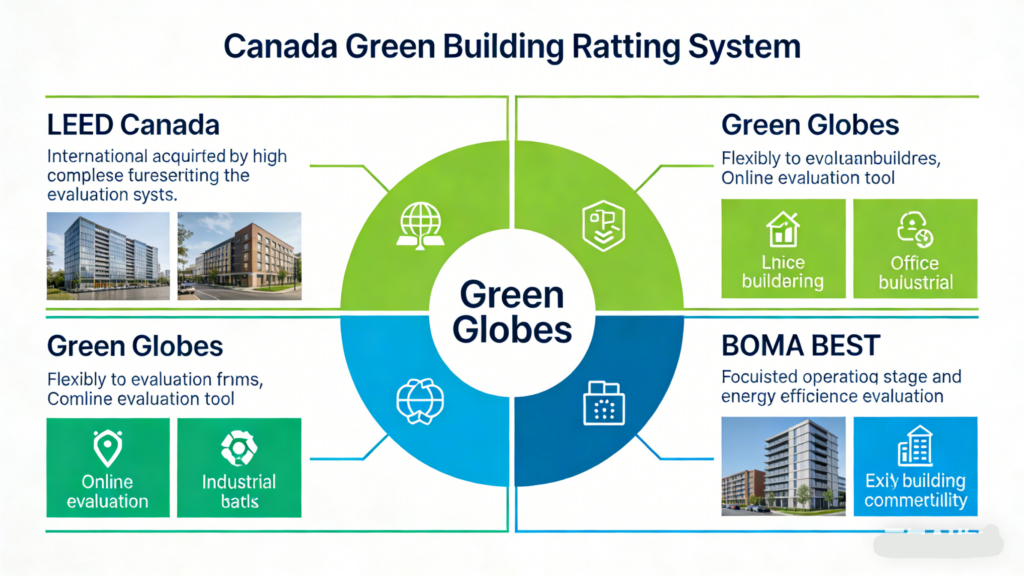
In addition to mandatory green features in model codes, Canada boasts a robust ecosystem of voluntary green building rating systems:
- BOMA BEST: Focuses on commercial building sustainability and operational efficiency;
- CSA BREEAM Canada: Adapts the global BREEAM framework to Canadian contexts;
- CSA Climate Change Buildings and Infrastructure: Addresses climate resilience in construction;
- Green Globes: A flexible, performance-based rating system for new and existing buildings;
- LEED® Canada: Tailored to Canadian climate and building practices (for new construction, major renovations, and operations);
- NRCan ENERGY STAR®: Recognizes energy-efficient buildings and appliances;
- EnerGuide: Rates building energy performance;
- R-2000: Focuses on energy efficiency, indoor air quality, and durability in residential buildings.
5. Key Takeaways
Canada’s building and fire code system is a dynamic, consensus-driven framework that balances national consistency with local adaptability. Key strengths include the early integration of green features into mandatory codes, provincial leadership in sustainability, and a diverse range of voluntary green building rating systems. For industry professionals, understanding the hierarchy of codes (federal → provincial → municipal) and the role of organizations like the CCBFC and CSA is critical to ensuring compliance and leveraging sustainable building practices.
Leave a Reply