Synopsis
This article provides a comprehensive overview of Australia’s regulatory framework for the building industry. It explores the centralized role of the Australian Building Codes Board (ABCB) in managing the National Construction Code (NCC) and explains how state and territory governments enforce these mandatory requirements. The post also details the integration of sustainability through the GEMS Act and the voluntary Green Star rating system, alongside technical standards for electrical, energy, and fire safety.
1. Code Administration and Enforcement
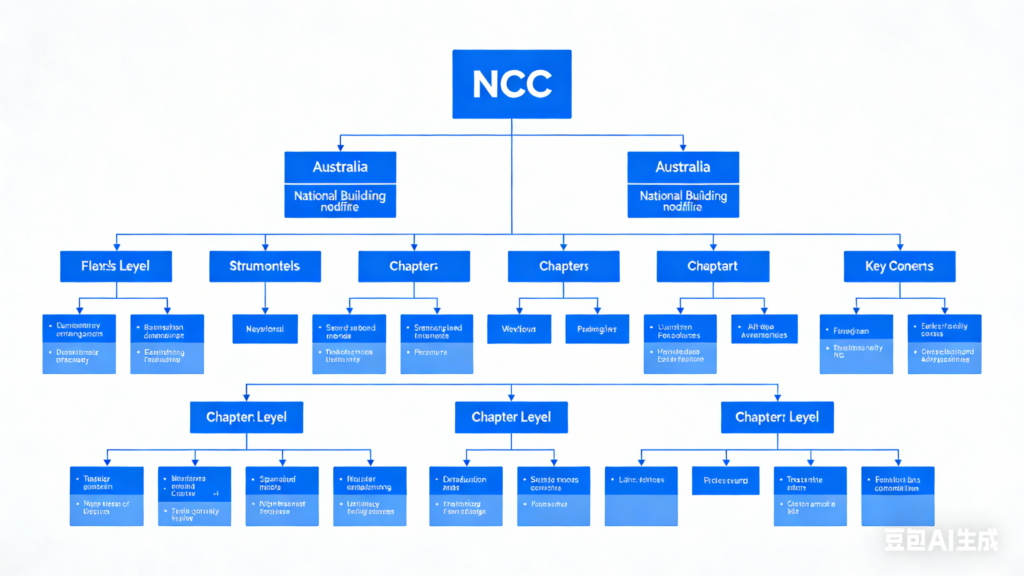
Australia utilizes a centralized approach to building code administration. The Australian Building Codes Board (ABCB) is the core body responsible for developing, maintaining, and administering the National Construction Code (NCC) on behalf of the Commonwealth as well as state and territory governments.
The Role of the NCC
Under the Inter-Governmental Agreement, the NCC is mandatory for all of Australia. It prevails over any conflicting local codes and regulations, ensuring a uniform set of technical provisions across the country while allowing for variations in climate and geological conditions.
Enforcement and Privatization
While the NCC is a national standard, the responsibility for enforcement lies with individual states and territories.
- Authority: State governments issue building permits and commissioning certificates.
- Privatization: Since the 1990s, building inspections and certifications have been largely privatized. Governments and local councils often engage private sector investigators to conduct inspections to enhance productivity.
2. Development and Structure of the Code
The NCC is comprised of three distinct volumes that ensure the health, safety, amenity, and sustainability of buildings:
- Volume 1: Building Code of Australia (BCA) – Applicable to all buildings except housing.
- Volume 2: Building Code of Australia (BCA) – Applicable specifically to housing.
- Volume 3: Plumbing Code of Australia (PCA) – Focuses on plumbing and drainage.
Building Classifications
The NCC divides buildings into four types based on their level of importance and hazard to life:
- Low Hazard: Structures with a low degree of hazard to life (e.g., farm sheds).
- Standard: Buildings not covered by categories 1, 3, or 4.
- High Occupancy: Buildings designed for a large number of people.
- Essential: Facilities essential to post-disaster recovery or associated with hazardous facilities.
3. Key Technical and Reference Standards
Australia relies on a mix of domestic and international standards to maintain its construction quality.
- National Standards: Primarily uses Australian Standards (AS) and joint Australia/New Zealand Standards (AS/NZS) developed by Standards Australia.
- International Standards: The NCC also references selective standards from the U.S. (ASTM, AISC), Europe (ISO), and the UK (BSI).
Minimum Code Requirements
- Electrical: Governed by the BCA and National Electricity Rules (NER), mandating AS/NZS 3000:2007 (Australian Wiring Rules).
- Fire Safety: Covers fire resistance testing (AS/NZS 1530), protection methods, and prevention systems.
- Mechanical: Regulates HVAC, lifts, and escalators through standards like AS 1668 and AS 1735.
4. Pathways to Green Building
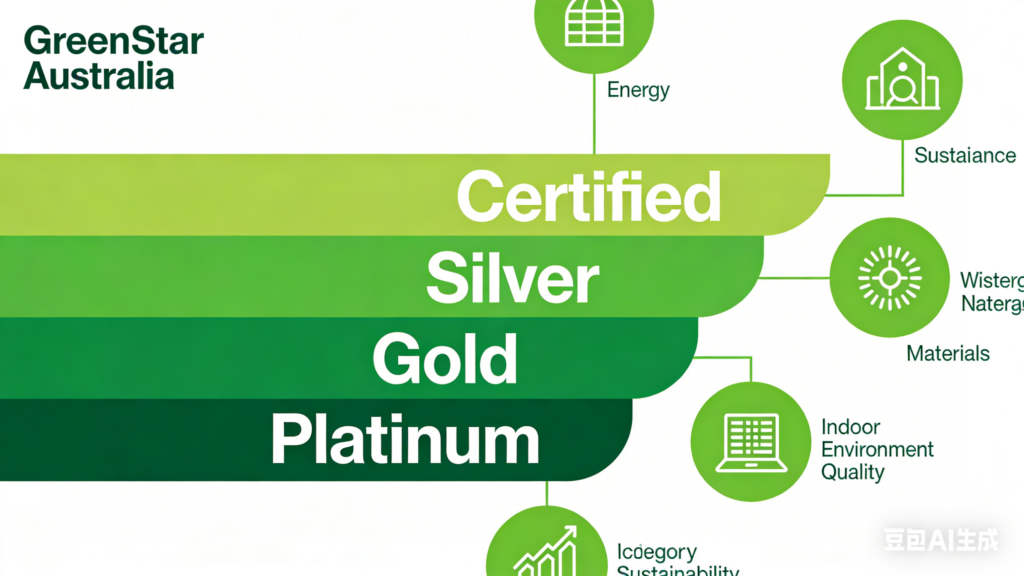
Sustainability in Australia is driven through legislative integration rather than a separate “Green Code.”
Mandatory Legislation
Green features are incorporated into the NCC through acts such as:
- GEMS Act 2012: Regulates energy efficiency for appliances (lighting, air conditioning, motors).
- Water Act 2007: Establishes efficiency and quality standards for faucets and fixtures.
- MEPS & ERL: Products must comply with Minimum Energy Performance Standards and Energy Rating Labels.
The Green Star Rating System
Launched in 2003 by the Green Building Council of Australia, Green Star is a voluntary rating system that scores buildings across nine categories, including indoor environment quality and emissions.
| Score | Rating | Signification |
| 45-59 | 4-Star | Best Practice |
| 60-74 | 5-Star | Australian Excellence |
| 75-100 | 6-Star | World Leadership |
Here is a detailed summary table of the specific Australian and International Standards mentioned in your document. You can insert this table into your WordPress post to provide a high-quality technical reference for your readers.
Quick Reference: Key Standards within the NCC
| Category | Standard ID | Description / Application |
| Electrical | AS/NZS 3000:2007 | Australian Wiring Rules: The primary standard for all electrical installations. |
| Electrical | AS/NZS 3017:2007 | Verification Guidelines: Sets out inspection and testing for low voltage installations. |
| Mechanical | AS/NZS 1668 | Use of mechanical ventilation and air-conditioning in buildings. |
| Mechanical | AS 1735 | Standard for lifts, escalators, and moving walks. |
| Mechanical | AS 4254 | Requirements for ductwork for air-handling systems. |
| Fire Safety | AS/NZS 1530 | Methods for fire tests on building materials, components, and structures. |
| Fire Safety | AS 1670 / 1905 | Fire protection methods against fire hazards and fire-resistant doorsets. |
| Fire Safety | AS 2118 / 2441 | Automatic fire sprinkler systems and fire hose reels. |
| Lighting | AS/NZS 1680 | Interior and workplace lighting requirements. |
| Lighting | AS 2293 | Emergency escape lighting and exit signs for buildings. |
| Plumbing | AS/NZS 3500 | National plumbing and drainage standards. |
| International | ARI 550/590 | (U.S.) Water chilling packages using the vapor compression cycle. |
| International | BS 7190 | (U.K.) Assessing thermal performance of low-temperature hot water boilers. |
| International | AISC 1987 | (U.S.) Steel construction standards used in fire prevention inspection. |
Leave a Reply